
For parents & educators
Free Learning Games for 5 and 6 Year Olds
Build a word, count a garden, and explain a clever choice. Mix familiar practice with a new challenge as early reading and reasoning grow.
Explore the games
Little steps, useful practice
What children can practise
- Counting pictures to ten
- Building familiar words
- Putting words into sentences
- Remembering and explaining patterns
Choose something to try
Games to explore
Games open at your child’s current profile Level. Read instructions together, use Listen where offered, and take a break whenever you like.
 Levels 5–6
Counting Garden
Count little garden treasures up to ten.
Play free Levels 5–6
Word Builder
Turn a handful of letters into a word.
Play free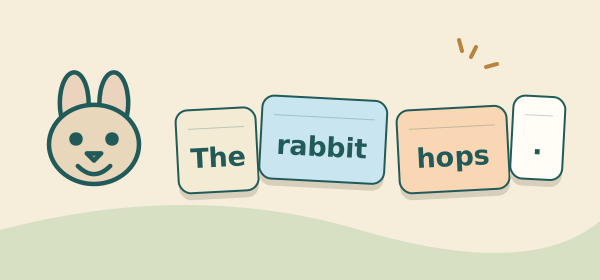 Levels 3–10
Momo’s Sentence Dominoes
Join word dominoes to make little sentences, then grow longer ideas.
Play free Levels 5–6
Memory Meadow
Find the meadow’s matching pairs.
Play free Levels 5–6
Nature Sort
Discover which garden friends are plants or animals.
Play free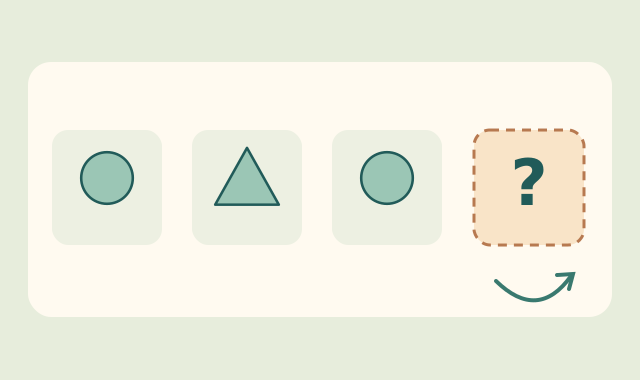 Levels 2, 4, 6, 8, 10
Momo’s Pattern Workshop
Notice repeating, growing and turning rules, then place a missing picture in the pattern.
Play free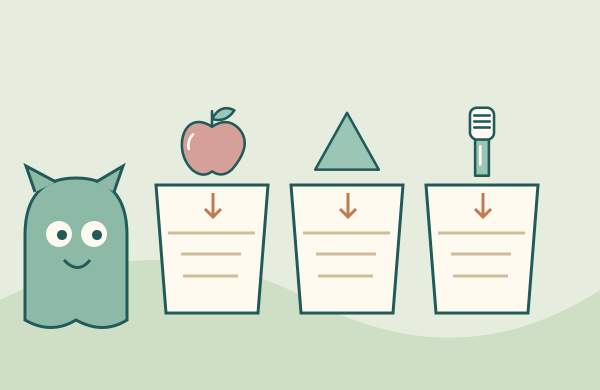 All levels
Momo’s Sorting Studio
Group shapes, everyday foods and care tools using clear properties or their named use.
Play free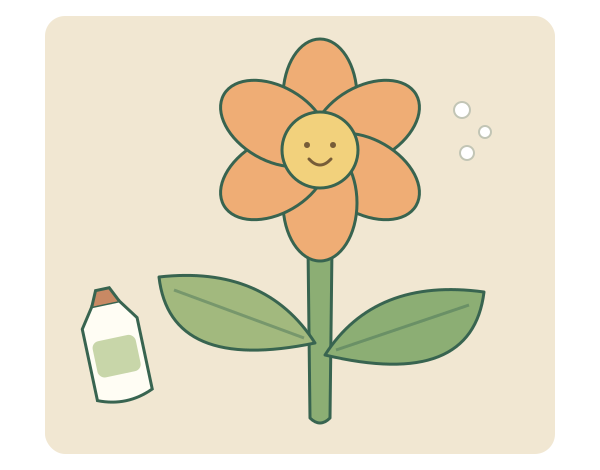 All levels
Glue & Stick
Make a paper flower while comparing glue amounts, planning layers and placing five shapes.
Play free
Help your child get started
Choosing games for a 5-year-old
Start with counting pictures or building a familiar word. Invite your child to point to each object or say the sounds while you help read the instruction.
Next steps for a 6-year-old
Try rearranging sentence dominoes or explaining a sorting rule. Read a completed sentence aloud together and discuss why a word or picture belongs in its place.
Try it at home
After a word or sentence game, draw its meaning together. Let your child tell a short story about the picture without needing to spell every word.
Try it in the classroom
Use sentence dominoes with a partner: one child proposes a word, the other reads the growing sentence. Swap roles and discuss another arrangement when supported.
A few useful answers
What if my five- or six-year-old finds a game too easy or difficult?
Use the shared profile controls to try another Level. There is no Level selector inside a game. Earned discoveries remain, and activities that support saved boards resume the board for the matching curriculum band.
How do we choose a Level and start playing?
Open a game or Go to Worlds, then choose a Level using the shared profile controls if you have not chosen one yet. Levels 1–2 correspond to the age-two band, 3–4 to ages 3–4, 5–6 to ages 5–6, 7–8 to ages 7–8, and 9–10 to ages 9–10. The first Level in each pair offers a starter collection; the second offers a fuller collection. Age is guidance, and a discovery-page link does not change the profile.
Are the games free, and where is progress saved?
The activities are free to play without creating an online account. Profiles and supported activity progress stay in this browser on this device. They do not sync between devices. Private browsing, blocked storage or clearing browser data can prevent saving or remove local progress.