
For parents & educators
Free Learning Games for 7 and 8 Year Olds
Follow an idea a little further. Explore number problems, richer sentences and patterns in the world, with time to explain how an answer works.
Explore the games
Little steps, useful practice
What children can practise
- Addition and subtraction
- Equal rows and factor pairs
- Word meanings and sentence order
- Sequencing life cycles
- Finding and explaining rules
Choose something to try
Games to explore
Games open at your child’s current profile Level. Read instructions together, use Listen where offered, and take a break whenever you like.
 Levels 7–10
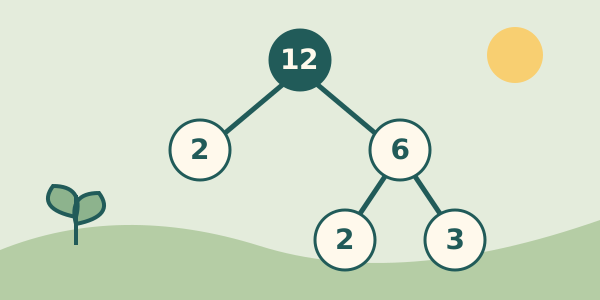
Momo’s Factor Forest
Find factor pairs with equal rows, then grow trees of prime factors.
Play free Levels 7–8
Number Garden
Grow your addition and subtraction skills.
Play free Levels 7–8
Word Opposites
Discover words with opposite meanings.
Play free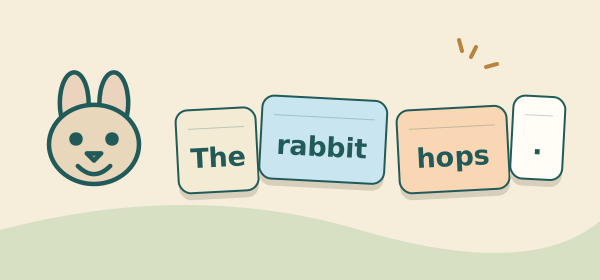 Levels 3–10
Momo’s Sentence Dominoes
Join word dominoes to make little sentences, then grow longer ideas.
Play free Levels 7–8
Life Cycle Garden
Discover how living things grow.
Play free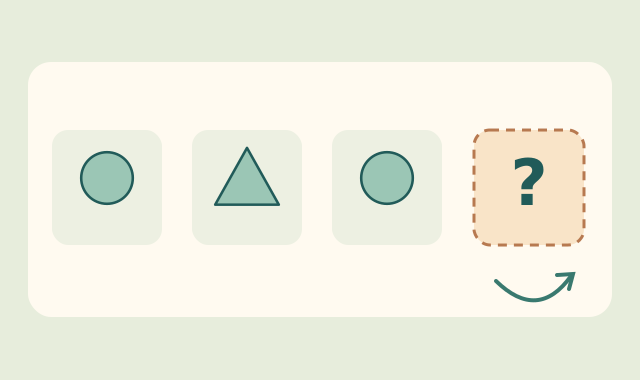 Levels 2, 4, 6, 8, 10
Momo’s Pattern Workshop
Notice repeating, growing and turning rules, then place a missing picture in the pattern.
Play free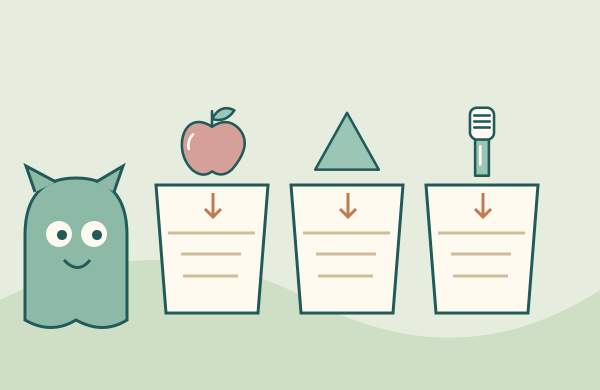 All levels
Momo’s Sorting Studio
Group shapes, everyday foods and care tools using clear properties or their named use.
Play free All levels
Momo’s Solar System Explorer
Explore our Solar System through 36 fact topics, interactive models and questions chosen for your profile level.
Play free All levels
Word Search Garden
Find little words. There’s always another puzzle!
Play free
Help your child get started
Practice for a 7-year-old
Ask your child to describe a number problem before choosing an answer. Counters or a drawing can help connect the picture to addition and subtraction.
Investigation for an 8-year-old
After arranging a life cycle or a sentence, ask what would change if two parts were swapped. Encourage a reason, then revisit the activity to check the idea.
Try it at home
Turn a completed sentence into a little spoken story. Add a detail about where or when it happened, then compare it with the original idea.
Try it in the classroom
Pause before checking a puzzle and ask pairs to explain their choices to each other. Compare methods with drawings or objects, not just final answers.
A few useful answers
Do these games follow a particular school curriculum?
These guides describe the skills in the activities rather than claiming alignment with a national curriculum. Teachers can preview a task and decide how it fits their own lesson goals.
How do we choose a Level and start playing?
Open a game or Go to Worlds, then choose a Level using the shared profile controls if you have not chosen one yet. Levels 1–2 correspond to the age-two band, 3–4 to ages 3–4, 5–6 to ages 5–6, 7–8 to ages 7–8, and 9–10 to ages 9–10. The first Level in each pair offers a starter collection; the second offers a fuller collection. Age is guidance, and a discovery-page link does not change the profile.
Are the games free, and where is progress saved?
The activities are free to play without creating an online account. Profiles and supported activity progress stay in this browser on this device. They do not sync between devices. Private browsing, blocked storage or clearing browser data can prevent saving or remove local progress.