
For parents & educators
Free Learning Games for 9 and 10 Year Olds
Make connections, test a route, and build a longer idea. Choose a focused practice activity or take time over a puzzle with more than one step.
Explore the games
Little steps, useful practice
What children can practise
- Multiplication and number relationships
- Factor pairs and prime factorization
- Longer sentences and joined ideas
- Vocabulary and careful reading
- Planning routes and exploring space
Choose something to try
Games to explore
Games open at your child’s current profile Level. Read instructions together, use Listen where offered, and take a break whenever you like.
 Levels 7–10
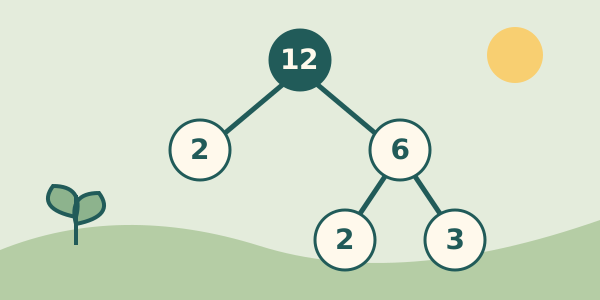
Momo’s Factor Forest
Find factor pairs with equal rows, then grow trees of prime factors.
Play free Levels 9–10
Times Trail
Follow a trail of multiplication puzzles.
Play free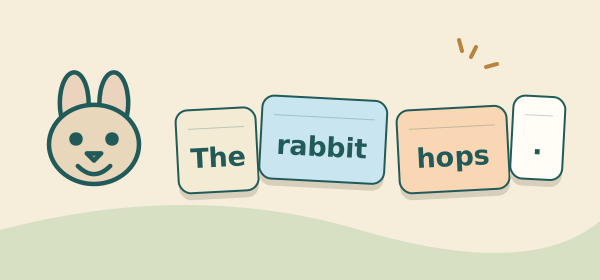 Levels 3–10
Momo’s Sentence Dominoes
Join word dominoes to make little sentences, then grow longer ideas.
Play free Levels 9–10
Sentence Safari
Put wandering words into a sentence.
Play free Levels 9–10
Space Explorer
Get to know our solar system.
Play free Levels 9–10
Pathfinder
Find a path through a little garden maze.
Play free All levels
Momo’s Solar System Explorer
Explore our Solar System through 36 fact topics, interactive models and questions chosen for your profile level.
Play free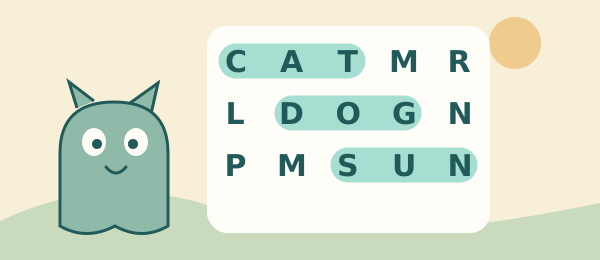 All levels
Word Search Garden
Find little words. There’s always another puzzle!
Play free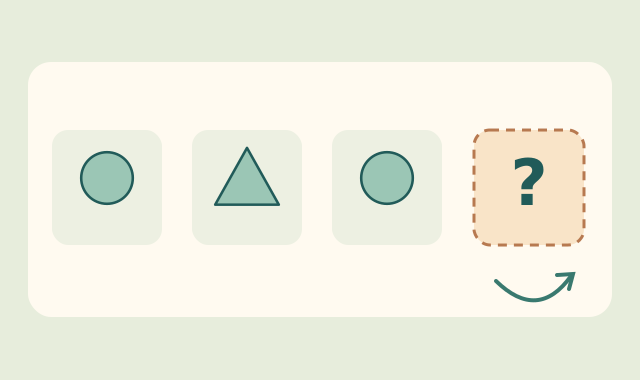 Levels 2, 4, 6, 8, 10
Momo’s Pattern Workshop
Notice repeating, growing and turning rules, then place a missing picture in the pattern.
Play free
Help your child get started
Starting with a 9-year-old
Invite your child to explain a multiplication result using equal groups. If a fact is unfamiliar, draw it or use objects before returning to the game.
Extending play for a 10-year-old
Ask for a plan before a route puzzle or for an explanation of how two sentence clauses connect. Offer a hint when needed and leave time to revise an idea.
Try it at home
After a space activity, choose one question to investigate together in a trusted book or resource. Separate what the game showed from what you still want to find out.
Try it in the classroom
Use a puzzle as a discussion starter: children record a first plan, try it, and describe what they would change. Value a clear explanation as well as completion.
A few useful answers
Can older children revisit simpler activities?
Yes. The shared profile controls allow another Level without removing earned discoveries. A familiar matching, drawing or pattern task can be useful for explaining ideas or enjoying a quieter activity.
How do we choose a Level and start playing?
Open a game or Go to Worlds, then choose a Level using the shared profile controls if you have not chosen one yet. Levels 1–2 correspond to the age-two band, 3–4 to ages 3–4, 5–6 to ages 5–6, 7–8 to ages 7–8, and 9–10 to ages 9–10. The first Level in each pair offers a starter collection; the second offers a fuller collection. Age is guidance, and a discovery-page link does not change the profile.
Are the games free, and where is progress saved?
The activities are free to play without creating an online account. Profiles and supported activity progress stay in this browser on this device. They do not sync between devices. Private browsing, blocked storage or clearing browser data can prevent saving or remove local progress.